Indian "Kamala" Cultural Doll
Namaste, main Kamala hoon!
Namaste! My name is Kamala (कमला) and I am from the Land of Festivals, India! In my country, my name means "lotus" in Sanskrit, a symbol embraced by various spiritual traditions in India. I am embraced by many people across different Indian cultures and faiths!
Come along as I share my culture and help your child feel proud of where they come from, and to give any child a joyful window into a beautiful culture!
Let's Learn Together By Age!
How old is your child? You don't need to explain everything to them perfectly. Start with simple observations, gentle questions, and small conversations that grow with your child over time. Kamala is here to help make culture feel approachable, joyful, and connected to everyday family moments!
For Little Ones
Ages 2 to 4
Name the colors:
"Pink! Gold! How many bangles can you count?"
Name the clothing:
"This is called a lehenga. It's a special dress for celebrations."
Share a feeling:
"When Kamala gets dressed up, she feels proud. When do you feel proud?"
For Curious Kids
Ages 5 to 7
Talk about celebrations:
"Kamala might be getting ready for Diwali. What do we celebrate in our family?"
Compare and connect:
"In India, the lehenga is like a celebration outfit. What's ours?"
Introduce a tradition:
"Share one food, word, or ritual from your heritage."
For Growing Thinkers
Ages 8 to 12
The lehenga has roots in the Mughal era, shaped by centuries of cultural blending.
There is no single "Indian" way. Styles vary across Gujarat, Rajasthan, Punjab, and Tamil Nadu.
Ask:
"What does it mean to be proud of where you come from?"
If You're Still Finding Your Way Back…
Maybe you grew up between cultures. Maybe some traditions were lost along the way. Maybe you're not sure you're the right person to teach this.
Trust me, you are.
You don't need to have all the answers to pass on pride, curiosity, and love. Start small. Learn alongside your child. Let Kamala be the beginning of a conversation, not the completion of one.
Children don't need perfect keepers of culture. They need parents and educators who are curious enough to keep exploring with them.
The Story of Kamala's Dress
In this section, Kamala will introduce her outfit and help you teach your children how to talk about each piece with confidence!
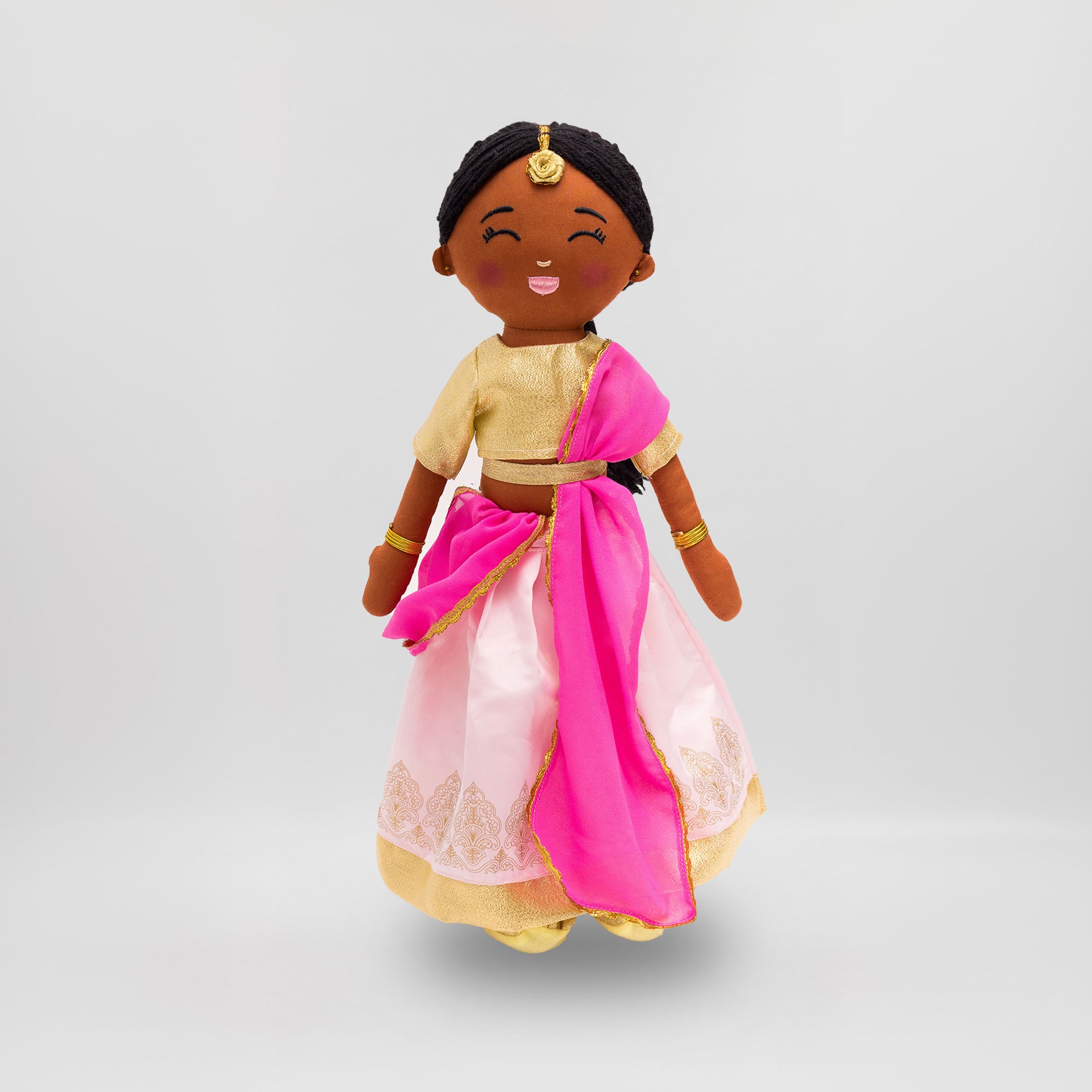
Kamala's attire is called a , a traditional outfit that carries deep cultural and historical significance. Originating from the Mughal era, this ensemble reflects a fusion of indigenous and foreign influences. Through the years, the outfit has undergone several transformations to fit the evolving times. In the 20th century, it became more modernized; the blouse became shorter and the skirt became more fitted.

(चोली)
The choli is a fitted blouse traditionally worn with Indian lehengas and sarees. Kamala's cream and gold choli adds elegance while celebrating the beauty of South Asian clothing traditions.

(कमरबंध)
A kamarbandh is a decorative waist accessory often worn with traditional Indian outfits. Kamala's kamarbandh brings a graceful finishing touch inspired by festive South Asian fashion.

(दुपट्टा)
The pink dupatta is a flowing scarf traditionally paired with Indian outfits. Its bright color and gold trim add movement, warmth, and cultural detail to Kamala's look.

(लहंगा)
The lehenga is a long flowing skirt traditionally worn during celebrations, weddings, and cultural festivals across India. Kamala's soft pink lehenga features delicate gold details that add elegance and movement to her outfit.
Kamala's Golden Accessories
In Indian culture, gold jewelry symbolizes beauty, prosperity, and femininity. The bangles create a gentle jingling sound that reflects the rhythm and vibrancy of Indian traditions. The tikka represents auspiciousness and good fortune, while the bindi symbolizes wisdom, devotion, and inner strength. Together, these meaningful details complete Kamala's look with timeless grace.

Earrings
Kamala's gold earrings add a touch of elegance while honoring an important part of Indian tradition. In Indian culture, earrings are often seen as symbols of beauty passed down across generations as meaningful adornments.

(चूड़ियाँ)
Churiyan, or gold bangles, are a traditional part of Indian jewelry and are often associated with prosperity, femininity, and celebration. Their layered design and gentle jingling sound make them both meaningful and beautiful cultural accessories.

(टिक्का) and (बिंदी)
The tikka is a traditional forehead ornament worn during celebrations and special occasions in India, often seen as a symbol of good fortune, beauty, and spiritual connection.
The bindi is a small decorative mark placed on the forehead that represents the third eye, believed to be the center of insight and spiritual awareness.
Say It In Your Language!
India has 22 officially recognized languages, with Hindi, Punjabi, and Tamil among the most widely spoken. Tap on each flashcard to discover how different pieces of Kamala's traditional outfit are pronounced in each language.
Skirt
Hindi/Urdu
Punjabi
Tamil
Blouse
Hindi/Urdu
Punjabi
Tamil
Scarf
Hindi/Urdu
Punjabi
Tamil
Bangles
Hindi/Urdu
Punjabi
Tamil
Forehead Dot
Hindi/Urdu
Punjabi
Tamil
Waist Belt
Hindi/Urdu
Punjabi
Tamil
Indian Holidays That Kamala Celebrates
Indian celebrations are filled with color, music, family traditions, special foods, and meaningful customs passed down through generations. Across different regions and communities, these moments are often used to bring people together, celebrate important values, and share stories that connect children to their culture and heritage.
Diwali: Festival of Lights (October / November)
What it is: The most widely celebrated South Asian festival. Observed by Hindu, Jain, Sikh, and some Buddhist communities. A celebration of light over darkness and good over evil.
History in brief: In Hindu tradition, Diwali marks the return of Lord Rama to Ayodhya after 14 years in exile. In South India it celebrates Lord Krishna's defeat of Narakasura. In the Sikh tradition it marks Guru Hargobind Ji's release from imprisonment. In Jain tradition, it commemorates the enlightenment of Lord Mahavira. One date, many stories, all centered on the triumph of light.
What families do: Light diyas, share mithai, wear new clothes, draw rangoli, exchange gifts, and visit family.
In a Western context: Many diaspora families light candles instead of diyas, buy mithai locally, and hold a quiet prayer at home. All versions count.
Use with Kamala: "Kamala is getting dressed for Diwali. Can we light a candle and think of one good thing we want to bring into our home this year?"
Cross-cultural connection: Lighting candles to mark something sacred: Hanukkah, Christmas, Kwanzaa, Eid. Every culture has a way of saying: we choose light.
Holi: Festival of Colors (February / March)
What it is: The festival of spring, color, and new beginnings.
History in brief: Holi celebrates the story of Prahlad, a devoted young boy whose faith protected him from his own father's attempts to destroy him. On Holi, social divisions dissolve. The throwing of color powder is an act of equality and joy.
What families do: Throw colored powder, eat gujiyas, sing and dance, and forgive old grievances.
Use with Kamala: "Holi is a day when everyone plays together with color and nobody is left out. What color would you throw at Kamala?"
Navratri: Nine Nights (September / October)
What it is: A nine-night festival honouring Durga, the goddess of strength. Famous in Gujarat for garba dancing.
History in brief: Nine nights of Durga's battle against the demon Mahishasura, a story of endurance and ultimate victory. In Bengal it is Durga Puja, marked by elaborate public idol installations.
Use with Kamala: "Nine nights of dancing and celebrating strength. What dance would you teach Kamala?"
Baisakhi: Harvest Festival & Sikh New Year (April 13/14)
What it is: A harvest festival and Sikh New Year, especially significant for Punjabi communities around the world.
Use with Kamala: "Baisakhi is the Punjabi New Year, a time to give thanks and begin something new. What's one thing you're grateful for today?"
Eid al-Fitr (Date Changes Each Year)
Relevance: The lehenga is worn by Muslim families in India, Pakistan, and Bangladesh during Eid. This cross-faith connection is an important part of understanding South Asian culture.
Use with Kamala: "Kamala's lehenga is worn by families of many different faiths. On Eid, families dress in their finest and share food and love."
Cross-cultural connection: The end of reflection followed by communal celebration: Yom Kippur, Lent and Easter, and many others.
Everyday Conversations With Kamala
Kamala's traditions are not only for special occasions, they can also be part of everyday life. From the clothes she wears to the language she speaks and the values she carries, Kamala helps children see how culture can live in daily routines, family moments, kindness, respect, and connection to community.
Here are some questions that can help spark curiosity and encourage deeper conversations with your child about the Indian culture.
"What's one thing Kamala would want to dream about?" Or: "Let's give Kamala a bedtime story from our family."
"If Kamala came for dinner, what would we cook for her?" A simple question that can open into family food memories and traditions.
"Kamala's wearing a lehenga. What's the most special thing you've ever worn?"
"Kamala celebrates Diwali. Let's find out what that means together." Then explore the holiday guide together on this page.
"We come from a place where people dress like this, celebrate like this, and love their families just like we do. You carry that with you everywhere."
What To Say When Your Child Asks…
How Is Kamala's Life Different From Mine?
Why does Kamala celebrate different holidays than I do?
Families around the world celebrate different holidays based on their traditions, beliefs, and cultures. Kamala's family celebrates holidays that are meaningful to them, just like your family may celebrate holidays that are special to you.
Why does Kamala sometimes wear different clothes?
People wear different types of clothing depending on their culture, the weather, and special occasions. Kamala may wear traditional Indian clothing during celebrations, just as some people wear special outfits for holidays or family events.
Why does Kamala eat foods I've never tried before?
Every culture has its own favorite foods and recipes. Kamala's family enjoys dishes that are common in Indian homes, while your family may have different favorite meals. Trying new foods can be a fun way to learn about other cultures.
Why does Kamala speak more than one language?
Many people around the world grow up speaking more than one language. Kamala may use different languages at home, at school, or with relatives. Knowing multiple languages can help people communicate with more friends and family members.
How Is Kamala's Life Similar To Mine?
Does Kamala go to school like I do?
Yes! Kamala goes to school, learns new things, works on projects, and spends time with classmates, just like many children around the world.
Does Kamala have friends like I do?
Absolutely. Kamala enjoys spending time with friends, sharing experiences, playing games, and learning together, just like you do.
What games does Kamala like to play?
Kamala enjoys many of the same games children everywhere enjoy, including pretend play, board games, outdoor activities, and creative games with her dolls and friends.
What does Kamala do for fun after school?
After school, Kamala might play with friends, read books, help her family, enjoy hobbies, or spend time doing activities she loves, just like many children do.
Why Does Kamala Celebrate That?
What is Diwali?
Diwali is often called the Festival of Lights. It is celebrated by millions of people around the world and is a time for family gatherings, lights, decorations, food, and celebrating hope, goodness, and new beginnings.
Why do families light lamps during Diwali?
Small lamps and lights are used during Diwali to symbolize light overcoming darkness and hope overcoming challenges. The lights help create a warm, welcoming atmosphere.
Why are celebrations important to Kamala's family?
Celebrations bring families together, help people remember traditions, and create joyful memories. They help families stay connected to what matters most to them.
Do all Indian families celebrate the same holidays?
No. India is home to many religions, languages, and traditions. Different families celebrate different holidays depending on their beliefs, region, and customs.
Why Does Kamala Eat That?
What foods are common in Kamala's family?
Kamala's family may enjoy foods such as rice, lentils, vegetables, flatbreads, curries, yogurt, and many flavorful dishes prepared with herbs and spices.
Why do Indian foods use different spices?
Spices add flavor, aroma, and color to food. Different regions and families have their own favorite combinations that make meals unique.
What foods would Kamala and I both enjoy?
Many foods are enjoyed around the world. Kamala and you might both enjoy fruits, rice dishes, bread, noodles, soups, snacks, and sweet treats.
Can I try foods from Kamala's culture?
Of course! Trying foods from different cultures can be a fun way to learn about the world and discover new favorite flavors.
Why Does Kamala Wear That?
What is a choli?
A choli is a fitted top that is often worn with traditional Indian outfits such as a lehenga. It comes in many colors, fabrics, and styles.
Does Kamala wear traditional clothes every day?
Not usually. Like many children, Kamala often wears everyday clothes for school and play. Traditional clothing is often worn during festivals, celebrations, and family events.
When do people wear traditional clothing?
People often wear traditional clothing during holidays, weddings, religious events, cultural celebrations, and other special occasions.
Do children in India wear the same clothes as children in other countries?
Many children in India wear everyday clothing such as T-shirts, dresses, jeans, shorts, and school uniforms. Children around the world often have much more in common than they realize.
Why Does Kamala Speak That Language?
What languages are spoken in India?
India is home to hundreds of languages. Some widely spoken languages include Hindi, Bengali, Tamil, Telugu, Marathi, Gujarati, Punjabi, Kannada, Malayalam, and English.
Why do some people speak more than one language?
People may learn multiple languages through family, school, community, or where they live. Speaking more than one language can help people communicate with different groups of people.
Can Kamala speak English too?
Yes! Many children in India learn and speak English along with one or more additional languages. Kamala may use different languages depending on who she is talking to.
How do different languages help people connect?
Languages help people share ideas, traditions, stories, and experiences. Learning even a few words from another language can help build friendships and understanding.
Activities for Kids
Printable, playful, and designed to bring Kamala into everyday learning and family connection.
Meet Kamala's Friends
Every Joeydolls friend brings new words, new celebrations and new stories to explore together.

Kamala and Priya
Pair Kamala with Priya, her Indian doll friend, for twice the stories and pretend play.
Meet Priya Chinese Mei Signature Doll Meet Mei →
  Filipino Bayani Mini Doll Meet Bayani →
  Vietnamese Minh Mini Doll Meet Minh →
  Mexican Mateo Mini Doll Meet Mateo →
More Resources Here!
For Educators
Join educators across North America and Australia who are using Joeydolls to spark cultural pride, empathy, and belonging in their students.
Visit theJoeydolls Educators Program
Join the Joeydolls Insider Club
Want early access to new dolls, exclusive monthly activities, and a community of families who celebrate culture?
Join Insider ClubShare Your Kamala Story
We'd love to see how Kamala becomes part of your family's story. Whether she's joining everyday adventures, helping start meaningful conversations, or celebrating special traditions, your moments inspire families around the world.
Follow Joeydolls, tag us, and share how your family uses Kamala on Facebook, Instagram, TikTok and YouTube (@joeydolls). We love celebrating your journey together.
See Why Families Love Joeydolls
Every Joeydolls doll carries a story, and so do the families who welcome them home. Read heartfelt reviews from parents, grandparents, educators, and gift-givers who have made Joeydolls part of their family's journey.